
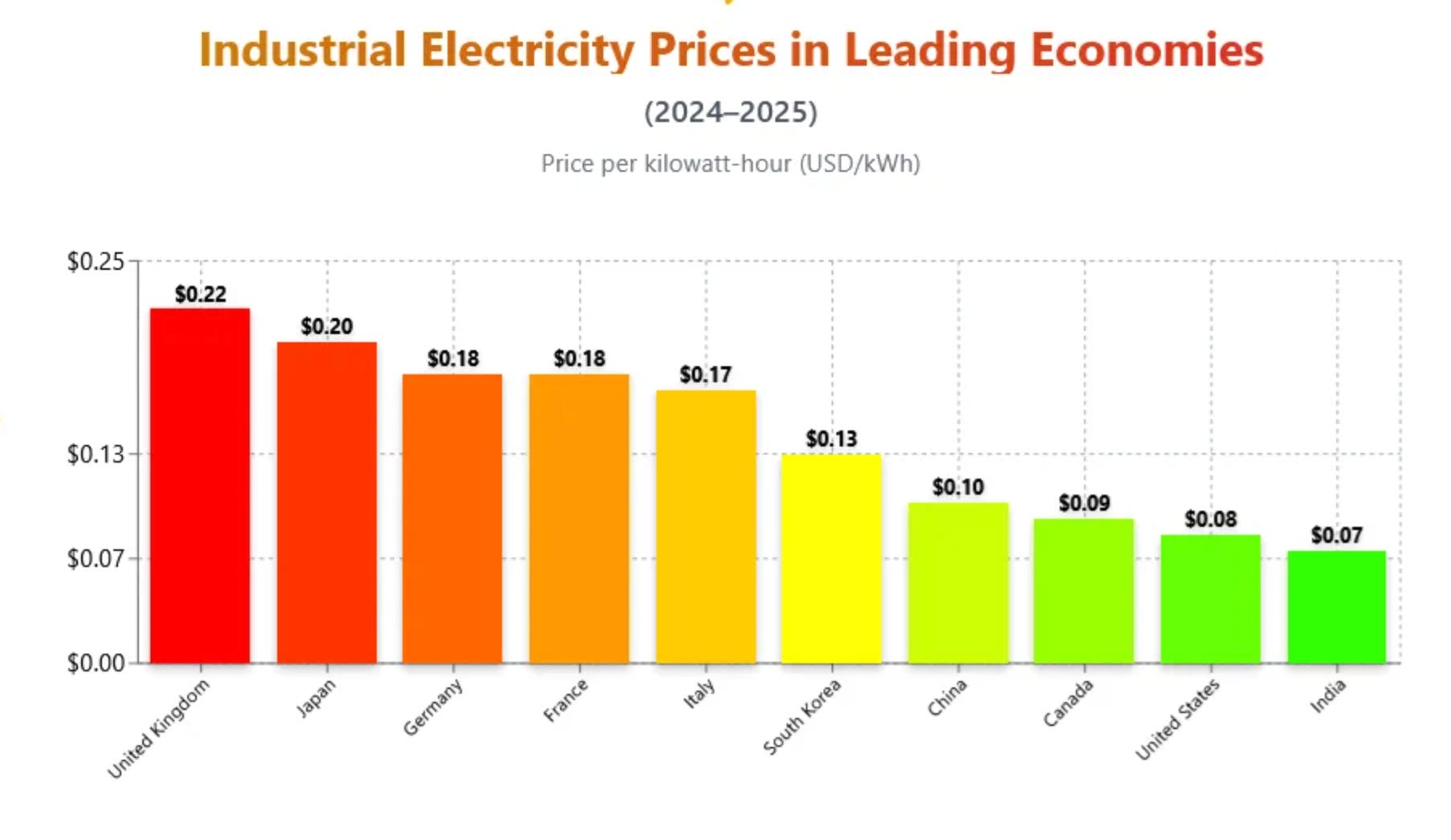
Industrial electricity prices in the EU are ~2.5x higher than in the US and China. This is often cited as a key reason why Europe is not a good place to build AI data centers. If this were true, it would be a serious problem for Europe, as AI compute is turning into a strategic resource and key input to the world economy.
I will argue that this concern is exaggerated. My reference point will be Germany, which has among the highest energy prices in Europe. I will make two main points:
Since the cost for an AI data center is mostly CapEx – including expensive GPUs, other IT equipment, and construction – higher electricity prices only marginally affect the total cost.
The premium is small enough to be absorbed by hyperscaler margins and more than compensated by two other advantages: Germany’s existing GW-scale grid connections and political stability.
Important caveat: This post is only about AI data centers. High electricity prices are a major concern for conventional, non-AI data centers (see, e.g., this recent Bitkom study). Moreover, while electricity cost is a less important factor for AI data centers than European discourse often suggests, it’s not irrelevant, either. Targeted measures, such as a subsidized industrial electricity price, could further boost Europe’s attractiveness as an AI data center region.
The electricity premium drives up costs only modestly
Industrial electricity costs around $0.18 per kWh in Germany, compared to $0.08 per kWh in the US. A 1 GW data center, assuming ~100% uptime, thus comes with a yearly electricity bill of around $1.6B in Germany and $0.7B in the US.1 If data centers were included in Germany’s subsidized industrial electricity price (Industriestrompreis) – planned to take effect retroactively from 1 January 2026 – the annual cost would be around $1.4B. Either way, the $700-900M difference in annual electricity cost is dwarfed by an estimated cost of $32B2 for building the data center in the first place. The table below shows how Germany’s higher electricity prices affect an AI data center’s total cost of ownership (TCO). They increase the TCO by 9-12%, assuming an operating time of 7 years and a 10% discount rate.3
A 9-12% cost increase is well within the margins of hyperscalers. For example, Amazon’s cloud segment currently has a 35% operating margin. If AWS built a data center in Germany, then all other things being equal, the electricity premium would reduce this margin to a still pretty comfortable 27%.4
Cost isn’t everything, anyway
Germany has two other strategic advantages that more than compensate for a modestly higher TCO.
First, it has several decommissioned industrial sites with existing, GW-scale grid connections. This means that arguably the biggest bottleneck to European data center buildout – grid connection taking several years – isn’t a concern at those German sites, at least with a couple of regulatory tweaks. With speed to power being the most important factor when selecting data center sites, Germany could turn this into a decisive asset.
Second, Germany – and Europe more generally – is a politically stable and predictable region, and quite generally a reliable partner. For example, there’s little risk of data centers being hit by Iranian Shahed drones, as happened recently in the UAE and Bahrain. Building compute in Germany and other European countries would therefore advance US AI companies’ interest in regional diversification across stable democracies.
Bottom line
It has become almost a meme in policy circles that high electricity prices make countries like Germany unviable for large-scale AI compute. I think this is overblown. A ~10% increase in annual electricity cost is well within hyperscaler margins and makes only a modest difference to the CapEx-heavy overall cost. Given other strategic assets, such as political stability or former industrial sites, Germans – and other Europeans, as well – should be more confident about domestic AI compute buildout.
This assumes 1 GW of total power draw, not just IT load.
The $30B estimate on Epoch AI’s website is rounded from the $32B figure in the underlying data center model, accessible here.
Here, I don’t take into account potential CapEx differences between building in the US vs. Germany. First, the majority of AI data center CapEx (likely > 2/3) is IT equipment and other location-independent factors. Second, while some non-IT cost (e.g. land, construction) differs regionally, the impact is ambiguous. Construction cost data shows that building in a European hub like Frankfurt ($11.6/W) is more expensive than in major US markets like Charlotte or Dallas ($9.5/W). On this assumption, the overall cost premium to operating an AI data center in Germany would increase from 12% (as shown in the table above) to 19%. However, this is likely too pessimistic. The most attractive German data center sites are decommissioned industrial areas, where energy infrastructure already exists and land is relatively cheap. Plausibly, building at those sites isn’t much more expensive, and perhaps even cheaper, than at many US sites. Therefore, I don’t think potential CapEx differences change the overall picture.
For simplicity, I ignore operating costs other than electricity.
One might object that margins for AI workloads are smaller than in the traditional cloud business. However, (1) even a 20% margin could absorb a cost increase of this size, and (2) AI margins could plausibly increase soon as real-world model utility and demand grows.