
All opinions expressed below are my own; I’m not speaking on behalf of the other Europe 2031 authors.
Frederike Kaltheuner has written a detailed and thoughtful critique of Europe 2031. I particularly appreciated that her piece is one of the public reactions that really engage with the substance of our scenario (alongside a recent commentary by a few German economists, to which I respond here). This is exactly the conversation that we wanted to start, and Kaltheuner is right that we share the same “sense of urgency” regarding the challenges that Europe is facing.
While I cannot engage with everything in her piece, I would like to respond to some central points, moving from the substantive to the methodological. (If “methodological” sounds boring to you, please bear with me: I believe this goes right to the heart of Europe’s current AI policy conundrum.)
But first, I want to start with two factual corrections.
1. Corrections
Statements in bolded italics are my paraphrases of Kaltheuner’s objections, not direct quotes.
‘Europe 2031 wants to deregulate and weaken labor protections.’
This is not our view. First, we don’t call for blanket deregulation. We criticize some regulations, for example those that make it very hard in Europe to realize strategic infrastructure projects in a reasonable amount of time. Building a new transmission line takes ten years in some European countries, which is a problem quite independently of AI. We strongly support other regulations, such as the EU’s GPAI Code of Practice with its protections against systemic risks from general-purpose AI, and we say so in the FAQ. Some of us have actively safeguarded the European AI Act while it was being negotiated.
Second, we don’t recommend weakening labor protections. We recommend a version of the Danish flexicurity model, which makes it easier for companies to automate labor while supporting workers through reskilling and generous income compensation. This weakens the right to a job in favor of a right to a livelihood – which is, give or take, what societies will anyway need at some point in a world of increasing labor automation. The alternative is strictly worse: keeping jobs artificially alive while European companies get outcompeted by AI-native competitors abroad only means that labor market disruption hits us even harder a few years later.
‘Europe 2031 ignores diffusion bottlenecks and assumes recursive self-improvement (RSI) and a hard AI takeoff.’
Nowhere in the scenario do we assume a closing of the RSI loop or a fast takeoff towards Artificial Superintelligence (ASI). Our scenario doesn’t even assume that Artificial General Intelligence (AGI) – AI systems cognitively on par with humans – has been reached by 2031.1 Incidentally, this is why many people in the Bay Area called out Europe 2031 for being too conservative.
The question of diffusion bottlenecks is, I think, not central to my disagreement with Kaltheuner. I personally take these bottlenecks seriously, although I think that at least some of them are overstated (e.g. if integrating AI into legacy companies is too slow, this opens up a lucrative opportunity to build AI-native companies from scratch). That said, my co-authors and I can all imagine diffusion going slower than we describe in the scenario.
The question is whether Europe would do just fine in such a world even if it didn’t take unprecedented action now. I’m not so sure about that. Many of the security implications will become pressing even if real-world economic diffusion takes longer. And if most of AI’s transformative impact arrives by 2041 rather than 2031, that’s still not a lot of time to prepare, given the magnitude of the challenge, the timelines of large-scale infrastructure buildout, and the average speed of economic and institutional reform in Europe. Given the state of European AI policy today, I’d expect Europe to be economically and geopolitically sidelined by 2041 no less than if AI diffused more quickly.
2. Compute
‘Your plan only works if you roll out the red carpet to hyperscalers.’
Kaltheuner correctly points out that Europe 2031 calls for an unprecedented, emergency-level buildout of compute. The goal is for Europe to host at least 15% of global AI compute by 2031, equivalent to over 50 GW of AI data center capacity. We welcome European companies to build a significant share of this infrastructure as sovereign data centers. But we are also realistic that, given the required volume of investment, European companies cannot fully shoulder this alone. Therefore, a major share will have to be built by US hyperscalers.
This is a feature, not a bug: If Europe offers US companies attractive sites to build data centers, it thereby gains physical leverage over the infrastructure on which AI depends. This means that Europe can ask for something in return, such as guaranteed access to frontier models on par with US customers. If US companies invest tens of billions into AI infrastructure on European soil, and its continued operation depends on European cooperation, it will be much harder to cut Europe off.
Kaltheuner worries about the price tag: Doesn’t this mean that we have to buy off the hyperscalers through tax breaks and a regulatory carte blanche? Why else would they build in Europe?
I don’t think tax breaks are actually necessary. Hyperscalers primarily care about time to power: they need to get data centers online as quickly as possible and are willing to pay a premium for this. If Europe can ensure fast time to power, hyperscalers will be happy to build here. (Regional de-risking – e.g. in order to be less dependent on one government – is another key reason to build outside the US.)
Fast time to power requires two things: First, Europe needs to accelerate the planning and permitting process. This isn’t a matter of killing regulation, but of going through the existing process at warp speed. Second, Europe needs to sort out its grid connection mess, including through transparent prioritization rules and removing ‘zombie projects’ from the connection queue.
This isn’t rolling out the red carpet to hyperscalers. Europe’s energy system needs these reforms anyway. And they also help European neoclouds to build sovereign data centers. If you ask European companies what they need to build more AI infrastructure here, they will tell you the exact same things as a hyperscaler.
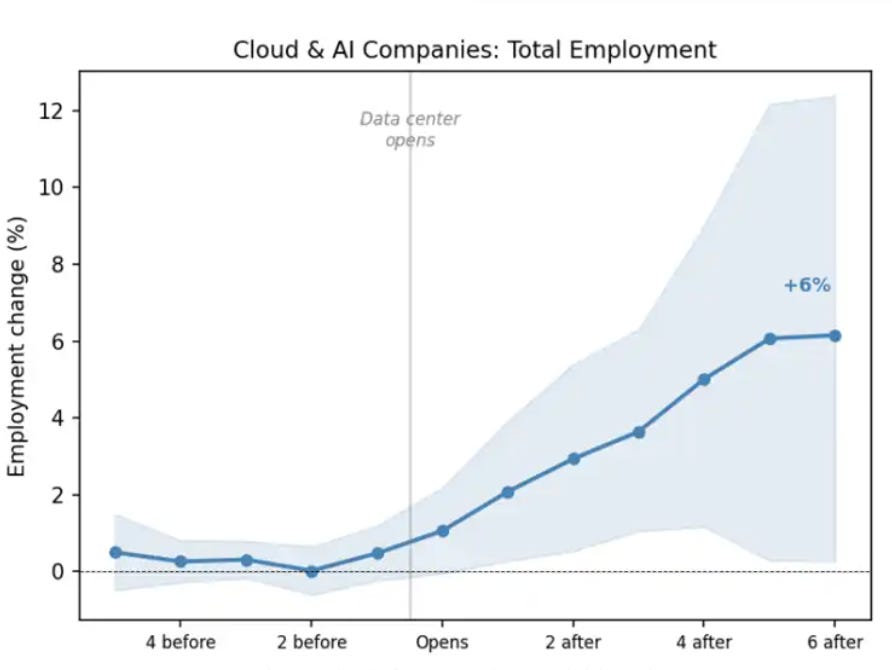
Instead of tax breaks, I actually believe the opposite is necessary: industry – and, if necessary, policymakers – should ensure that local communities benefit from data center buildout. This can be done through taxation, dedicated investment in local infrastructure or local job creation. For example, a Brookings study found that cloud and AI data centers in the US raise local employment by around 6% within 5 years – which is meaningful, though less than industry advocates have claimed. This is at current buildout levels: If Europe embarked on a crisis-level mobilization to build compute, one of my bigger worries is that there aren’t enough construction workers and electrical engineers.
‘Building a lot of compute is bad for the climate.’
I’m very sympathetic to the view that AI poses so many serious societal challenges – related to climate change, labor market disruption, power concentration, misuse concerns and loss of control, to name just a few – that we simply shouldn’t build AI systems above a certain capability threshold (and the required infrastructure) until we have figured out how to solve these problems. I just don’t think that Europe can make this more likely from its current position of weakness.
This means that, by default, the data centers will get built, and it’s just a question of where. TSMC will produce as many AI chips as it can and each of these chips will end up in a data center somewhere. Kaltheuner acknowledges this point when she says that “every gigawatt built in Europe is one not built in Virginia, the Gulf, or the ‘middle powers’ Europe is supposed to be negotiating with.”
This has an important, easily missed implication for Europe: If a data center gets built in Europe, this doesn’t lead to more data centers in the world. It just affects where the data centers are. From a climate perspective, the question then becomes: What is the climate impact of building in Europe rather than elsewhere?
From a CO2 emissions perspective, a data center itself is neither good nor bad for the climate. It depends on the energy sources that power it. Building data centers in regions with a high share of fossil-free energy, this is better than building it where energy mostly comes from burning coal or gas. Europe has many regions with a high share of fossil-free energy, such as the Nordics, France, Iberia and, to a lesser extent, the UK and Germany. All of these countries have cleaner grids than the US or China, which currently host the majority of AI data center capacity. Therefore, it would be better if more data center capacity ended up in Europe than in those countries.
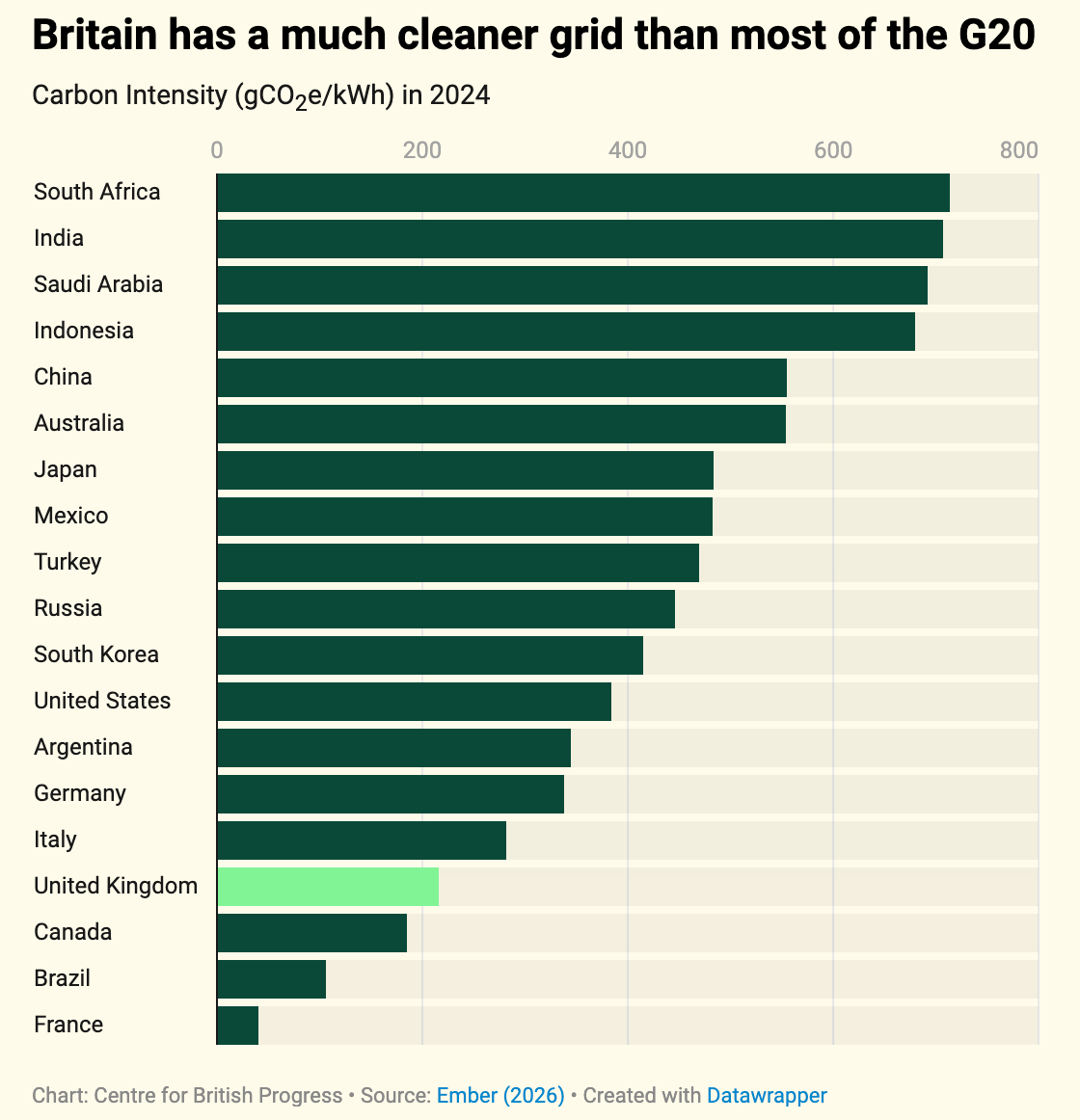
This is not to deny that large-scale compute buildout comes with trade-offs. While European grids are comparatively clean, building >50 GW of compute within 5 years might require some on-site or ‘behind-the-meter’ (BTM) power generation as a temporary solution while a data center awaits its connection to the grid. Grid-only data centers would be better from a climate perspective, because BTM power typically involves a share of natural gas, with batteries not yet cost-effective enough to power a data center 24/7 through renewables alone (though some promising projects in this direction are underway). I’m currently working with energy experts to better understand which grid vs. BTM share is compatible with Europe’s net-zero targets.
Ultimately, this comes down to a political question: Do we want to build out fossil-free energy and connect all data centers to a comparatively green grid, even if this means that onshoring AI infrastructure – and the leverage that comes with it – takes longer? Or do we allow more BTM generation, because we think that without compute Europe will lose its ability to act in a world of fast AI progress? Technical experts alone cannot settle this question; society as a whole needs to make this decision. Two points are worth noting in this context.
First, Kaltheuner points out that “we’re not even on track to power Europe’s current electricity consumption with renewables any time soon.” I agree with this, and believe that a high ambition on compute could actually help to boost Europe’s green transition in the medium term. Attracting hyperscalers with deep pockets to Europe and having them fund some of the necessary grid expansion, in return for priority access to relevant sites, would bring much needed investment into the European grid. In countries like the UK and Germany, data center buildout might even reduce electricity prices for consumers, as grid fees can be spread across more parties. Moreover, additional demand from data centers can make renewable energy projects economical that wouldn’t otherwise proceed.
Second, if Europe ended up geopolitically sidelined, as described in Europe 2031, because it failed to take transformative AI seriously, and the US (or China) concentrated power to the point of becoming a global hegemon – this would be a pretty bad outcome, for the climate, for democracy, and a lot of other things. This doesn’t make it inevitable to build 50 GW of compute. But any decision as to whether or not to do this has to take this into account.
A final note on compute: I actually don’t think Europe gets around large-scale buildout in any plausible scenario. Even if LLM progress stalled tomorrow, and compute was only used to integrate current models throughout the entire economy and research novel paradigms, Europe would need much more compute than it has now. I’m not sure whether it would need >50 GW. To those who are placing their bets on this scenario: I’d be excited to read a quantitative estimate of how much AI compute Europe needs under those assumptions; it won’t do to just say “models are getting more efficient and so we need less compute”. My hunch is that, even in a world very different from Europe 2031, Europe needs much more AI compute than the <2 GW it has right now. GPUs are too much of a general-purpose tool for computing, and computing is too much of a general-purpose tool for problem-solving, for that to be otherwise.
3. Frontier access
‘Europe 2031 is overly worried about frontier model access. Since the frontier is so competitive, the models might just commoditize and be widely available.’
I have explained in more detail elsewhere why I don’t find the commoditization thesis very plausible. To summarize: The leading companies benefit from compounding effects through revenue flywheels and internal AI R&D automation (even short of full RSI). This has already led to some consolidation within the US frontier, with OpenAI and Anthropic concentrating a lot of revenue and consistently training the best models. At the same time, a widening compute gap and efforts to prevent model distillation will likely make it harder for Chinese developers to compete. While Kimi K3 came closer to the frontier than many expected, my default assumption is that the frontier/sub-frontier gap will widen over the next two years. (For my tentative assessment of K3, see the Appendix below.)
The greater this gap becomes, the more of a premium people will be willing to pay for the frontier, and compute constraints further reduce the pressure to share frontier models with everyone. (This is why I’m skeptical about the market-shaping interventions that Kaltheuner suggests at the end of her piece. Market pressure only works if the US needs the European market, which is not clear will be the case.)
Misuse concerns about open models exacerbate this. In Europe 2031, both the US and China eventually ban open models after they reach Mythos-level cyber capabilities. Kaltheuner calls this a “plot device”. But the US has already demonstrated its willingness to restrict model access on security grounds, and according to recent reports, the Chinese government similarly considers banning its best models for foreign users. (Chinese AI companies might also go closed-source for independent business reasons.) Therefore, Europe cannot rely on remotely competitive open models being freely available in the future.
‘Even if Europe gets cut off from the frontier, it might do just fine. Small, widely available models might be sufficient for most tasks.’
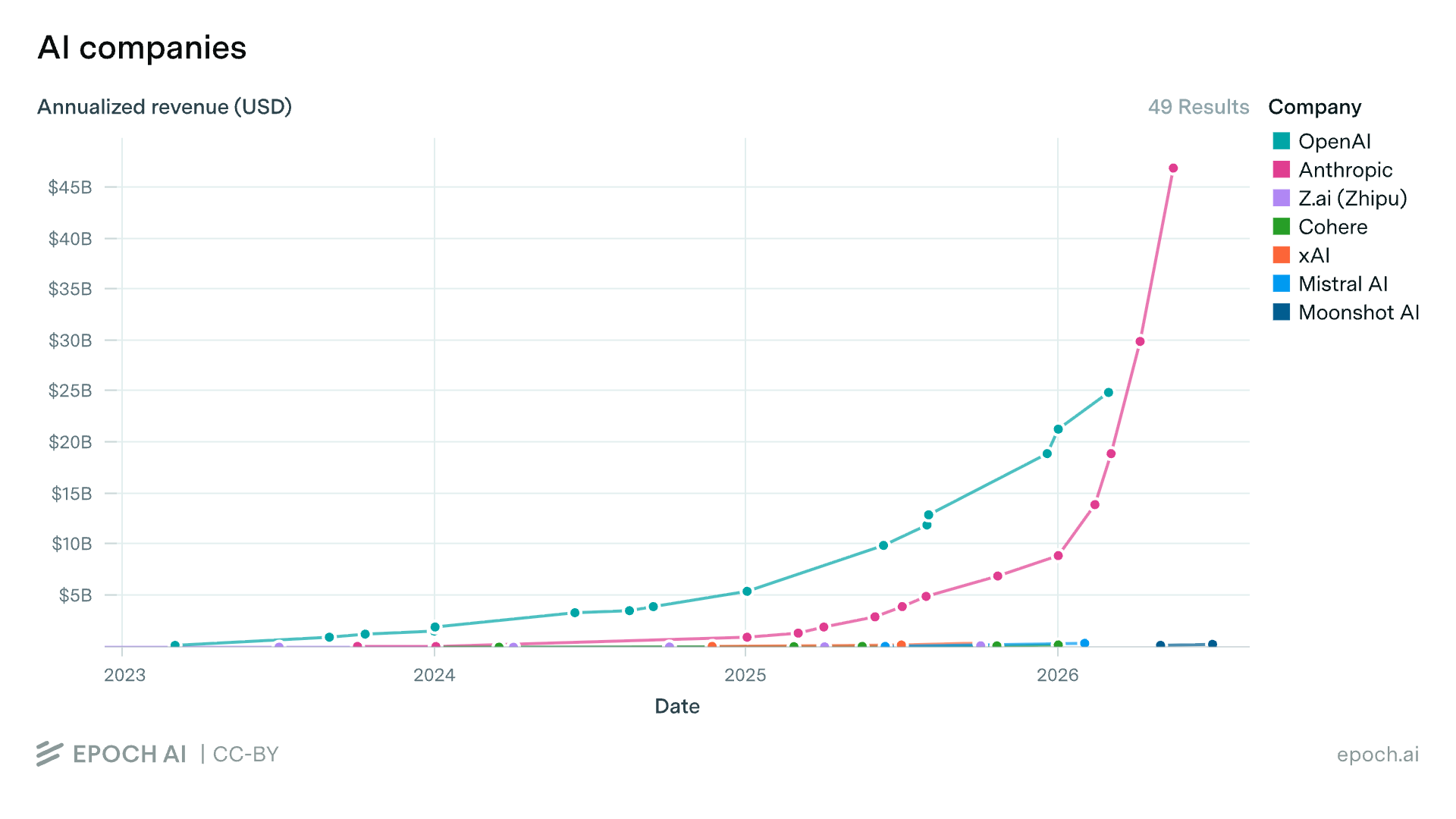
Contrary to Kaltheuner, I think that securing frontier model access is supremely important, on both economic and security grounds. From an economic perspective, I wouldn’t want to bet on a world in which frontier model access only marginally impact competitiveness. Today, AI is generating most real-world value in software engineering. Coding agents are a multi-billion-dollar market and the companies currently earning a majority of the model layer revenue are those selling frontier models. Enterprise customers, who are mainly driving these revenues, clearly think there’s a lot of value at the frontier.
Other considerations also suggest that frontier access is economically important:
In safety-critical domains, not using the best model could easily be seen as irresponsible.
Simon Grimm and Pieter Garicano point out that chaining together several less capable models is often not enough to reach the same performance as one more capable model: for example, no amount of GPT-4o instances could solve an Erdős problem, but GPT-5.6 can.
In many areas, small performance differences can matter a lot. For example, the difference between the best and a slightly worse sales pitch can decide who will get the contract.
Small differences seem particularly relevant in R&D. As Anton Leicht points out, privileged frontier model access could allow a company to start an ‘exponential innovation flywheel’ earlier than its competitors – designing a product, building and testing it, feeding the data back in to build an even better product, and so on – in a way that quickly compounds into a lasting advantage. This will become more relevant as AI increasingly underlies most innovation processes.
Another intuition pump: Future AI systems will increasingly replace human labor. And while a company doesn’t need all of its employees to be the best of the best, every successful company beyond a certain size surely has some people who excel at what they are doing. This suggests that, at least for larger companies, there will always be some area where frontier performance matters. If entire organizations are one day run by AI agents, it’s even more plausible that company success is a direct function of how capable the underlying agents are.
Even if we set the economics aside, Europe should ensure frontier model access for security reasons alone. Mythos demonstrates the importance of frontier models for cyber defense. This will only become more important over time, as new risk vectors like AI-enabled biological weapons or misaligned AI systems emerge. European governments are responsible for protecting the population against such threats, and they should make sure they have the best defensive instruments for that.
4. Areas of convergence
Before I move on to what I consider the most consequential disagreement with Kaltheuner, let me register two of her claims that I’m very sympathetic to.
‘Leading on industrial AI and robotics is actually very hard for Europe.’
One of Europe 2031’s recommendations is to build upon European strengths in industrial AI and robotics. However, there is a tendency in Europe to underestimate how difficult this is. Many people seem to believe that, given its valuable industrial data and successful manufacturing companies, Europe’s default chance of leading in this domain is high.
Kaltheuner rightly pushes back against this somewhat complacent view. US companies like Amazon or Jeff Bezos’ startup Prometheus are pursuing the same industrial AI bet, though with far more capital, compute and talent. China, South Korea and Japan will be similarly fierce competitors. I encounter a lot of unquestioned optimism about this in Europe, as if it were somehow a given that we will win the industrial AI race.
One reason I’m skeptical about this is the structural conservatism of European legacy companies. South Korea has ordered 260k GPUs, a large fraction of which for industrial AI, Bezos raised $12B for the same purpose, the Chinese government is pooling industrial datasets. I don’t see the same ambition in Europe.
Another reason is that, if you talk to technical experts, some (though not all) expect that large parts of industrial AI and robotics will be cannibalized by the general-purpose frontier (e.g. by fine-tuning leading LLMs on industrial data or training one big model with a shared embedding space across both language and non-language modalities). If this happens, there might be little room for industrial AI models built from scratch in Europe.
Though note that if this happens, access to frontier models – and closely integrating with the companies that build them, in ways that stay robust over time – becomes even more important for Europe. Developing industrial AI models is still a bet worth taking, as Kaltheuner says, since it’s one of the few areas where Europe’s relative chance of leadership is higher than elsewhere. But if Europe makes this bet, it has to pursue it with full dedication, and it needs to hedge against worlds where it doesn’t pay off.
‘If US companies develop frontier models while Europe only deploys them, the former might capture the majority of the value.’
I very much share this concern, which is one of the bigger worries about the leverage strategy as described in Europe 2031. One way to mitigate this risk is for Europe to increase its footprint both upstream and downstream of the model layer: Europe shouldn’t just try to capture value through downstream applications of frontier AI, but also by providing as many of the scarce inputs on which frontier AI depends as possible, such as semiconductor manufacturing equipment or specialized accelerators. Still, this is not guarantee against a world in which most of the value gets captured at layers that Europe doesn’t control, such as the cloud or model layer (as some recent evidence suggests is happening).
There are indeed good reasons to think that, on both economic and security grounds, AI is simply too important for Europe to rely on anyone else for frontier model access, no matter how tightly integrated such a partnership would be. In that sense, there clearly is a dissonance between Europe 2031’s sense of urgency, driven by its particular view of how AI is likely to develop, and the fact that we do not just recommend a serious European effort to train sovereign frontier models. One may therefore think that, on the spectrum between sovereignty-as-independence and sovereignty-as-interdependence, Europe 2031 leans too far towards the latter.
All that being said, three other things are also true. First, the amount of financial and (especially) political resources that would be required for such a project to have even a slight chance of success is unprecedented. I don’t see any willingness in Europe today to mobilize these resources. Doing this would force trade-offs that are much harder than anything we describe in Europe 2031; any call for European frontier models should be very honest about this. (Kaltheuner probably thinks that she doesn’t face these trade-offs, because on her view sub-frontier models will be enough for most use cases – which, as far as I can tell, she believes with about as much confidence as I believe the opposite.)
Second, if Europe tries to build its own frontier models half-heartedly, it will almost certainly fail and end up in the worst of all worlds: without its own frontier models and without the leverage to secure access from someone else. Given this, I believe that unless Europe radically ramps up its political will – which, again, I don’t see happening right now – the leverage strategy is the better play.
Third, even if there was enough political will for an ambitious frontier model push, any such attempt would still require US frontier model access, at least in the beginning. Without the ability to use the best coding agents, catching up will be even harder than it already is. This is why I think, in line with the Expert Forum recently convened by the European Commission, that securing frontier access is crucial whichever broader strategy Europe ultimately pursues.
5. Methodological objections
‘You base far-reaching recommendations on uncertain assumptions about the future. What if these assumptions are false?’
Kaltheuner introduces her critique of Europe 2031 as follows: “I’m going to spell out why its entire reasoning rests on a chain of assumptions, none of them certain”. I find this diagnosis surprising. On the one hand, I fully agree with the claim: Europe 2031 and its recommendations do rest on uncertain assumptions. On the other hand, I don’t follow the implicit “gotcha” – the idea that there is something unique, or uniquely shady, about this.
Everyone in AI policy bases their recommendations on uncertain assumptions about the future. If you think that AI progress will be much slower than Europe 2031 depicts, that frontier models will commoditize and that Europe will do just fine without large-scale compute, then these are also assumptions, and they are uncertain. If they turn out to be false, and Europe prepares for a world in which they are true, it has a serious problem. In either case, there’s no way around the uncertainty.
A reaction like Kaltheuner’s is a recurring theme in many AI policy conversations today. Someone would point to the many exponential trends in frontier AI, regarding rapid growth in capabilities, compute and revenue. These trends have been stable for years and if they continue, the economic, geopolitical and social implications will be somewhere between ‘pretty big’ and a civilizational phase-shift. Few people now dispute the last part. But many have a strong resistance to treating the “if” as a baseline scenario. What if the trends stall? What if the models commoditize? What if it’s a bubble?
One obvious rejoinder is: What if the trends don’t stall?
If the exponentials continue, the consequences would be so profound that Europe should prepare for this scenario, even if the chance that the scenario materializes are limited and preparing requires a high upfront cost. This is so especially because ambitious AI policy will help to fix other structural issues that are holding the continent back, such as long permitting timelines for infrastructure projects. Such reforms will be very useful to have in place when the next technological wave hits, even if it’s not deep learning.
This is one way to respond to Kaltheuner’s argument, but I increasingly think that it undersells its case. We’re not living in the 1990s, when some bold futurist painted a transformative AI scenario based on purely hypothetical considerations.2 Rather, many observable, real-world trends now point at a particular trajectory of future AI development, which is the broad trajectory that Europe 2031 describes. A few years ago, many found this trajectory implausible. Yet many of the things that AI experts predicted have already come to pass, such as AI capability advances in logic and mathematics, the rise of agentic AI, AI-related cyber risk, compute scarcity despite unprecedented buildout, rapid revenue growth, securitization and access restrictions or AI R&D boosts from early RSI.

This doesn’t mean these experts were right about everything. There is still deep uncertainty about the future and nobody has a crystal ball. But I don’t think we’re facing a 50/50 scenario anymore: The visible trends point in the direction of AI becoming radically transformative soon. It may still not happen, and that might be good news. But I don’t agree with the implication behind Kaltheuner’s claim that Europe 2031 “is just that: one possible future among many.” To me and many other observers, it looks like the baseline scenario.
‘Europe 2031 is gripping fiction, not transparent and tightly argued policy analysis.’
This is certainly tue, though I’m not quite sure what to make of it. My co-authors and I published technical AI policy papers before, which make Europe 2031’s key points in a more dispassionate way. It’s just that much fewer people engage with technical papers, so we tried something different.
The policy space benefits from a variety of formats. It needs both the dry, technocratic analysis – and I’m currently working on such a paper, covering similar themes as Europe 2031 – and more vivid formats that try to make a topic accessible to a wider audience.
6. Bottom line
I strongly agree with Kaltheuner when she cautions against treating the current trajectory of AI as a “force of nature”. How AI develops, and how it impacts our lives, depends on decisions that we make. It’s because of this belief that I’ve worked on Europe 2031.
Yet I also believe that Europe strongly underestimates just how strong a wave is going to hit it. There is still plenty we can do, but only if we appreciate where we’re headed by default.
Appendix: The US/China gap in light of Kimi K3
Take this with a grain of salt, as there has been limited opportunity to test the model in the real world and we’re still waiting for more information to come in.
My overall assessment so far is that while K3 is a strong model and closer to the US frontier than I would have expected, it’s not evidence of a narrowing gap between Chinese open-weight models and the leading US models. An analysis based on the Epoch Capabilities Index (ECI), a comprehensive score of model performance, shows that K3 is around 5 months behind the US, roughly in line with the previous trend:
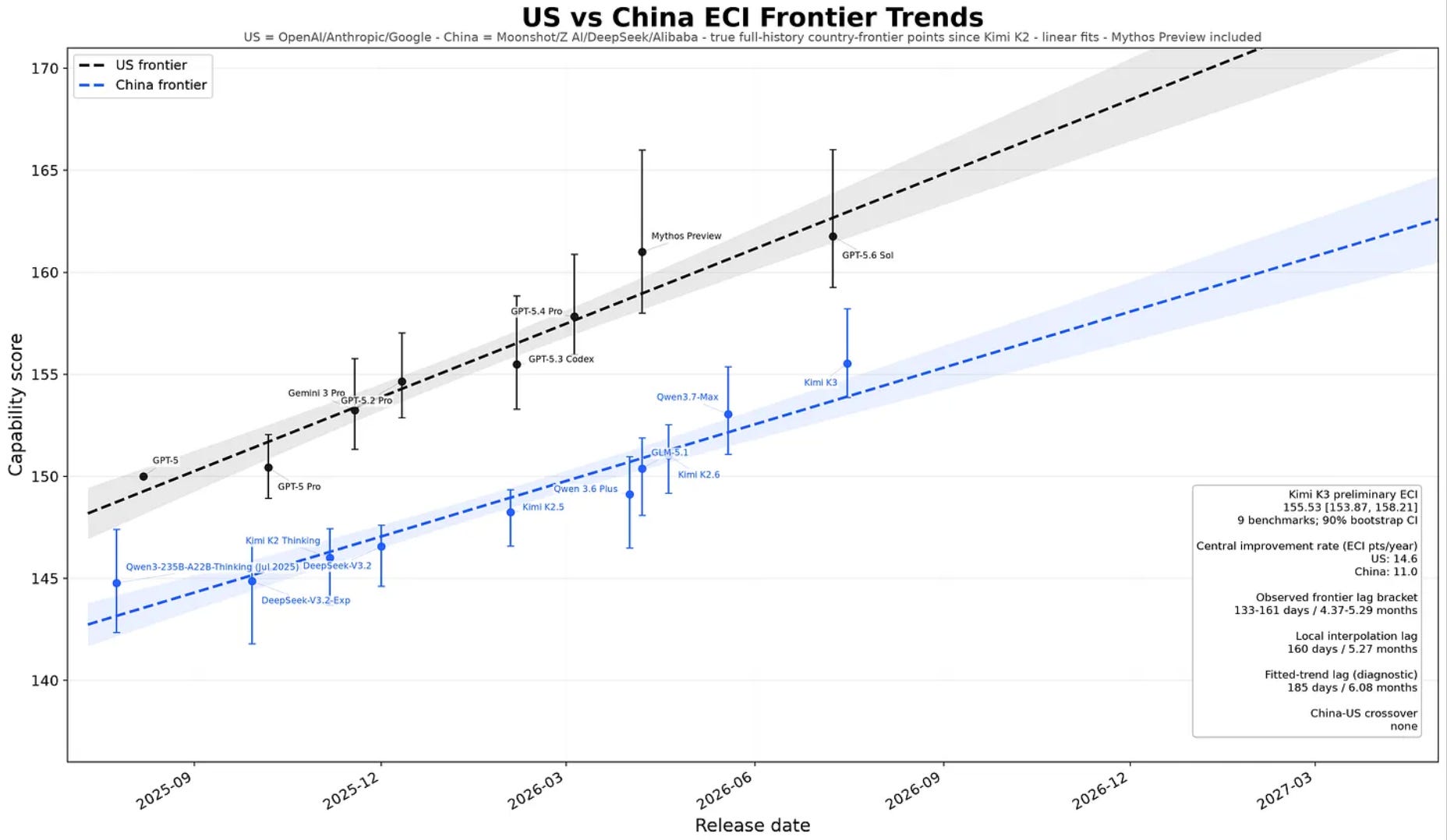
While K3 is somewhat above the general trendline, a look at individual labs shows that Moonshot (K3’s developer) isn’t progressing nearly as fast as Anthropic. While Moonshot’s trendline is about as steep as OpenAI’s and steeper than Google’s, the US ‘frontier frontier’ is, if anything, pulling further ahead:
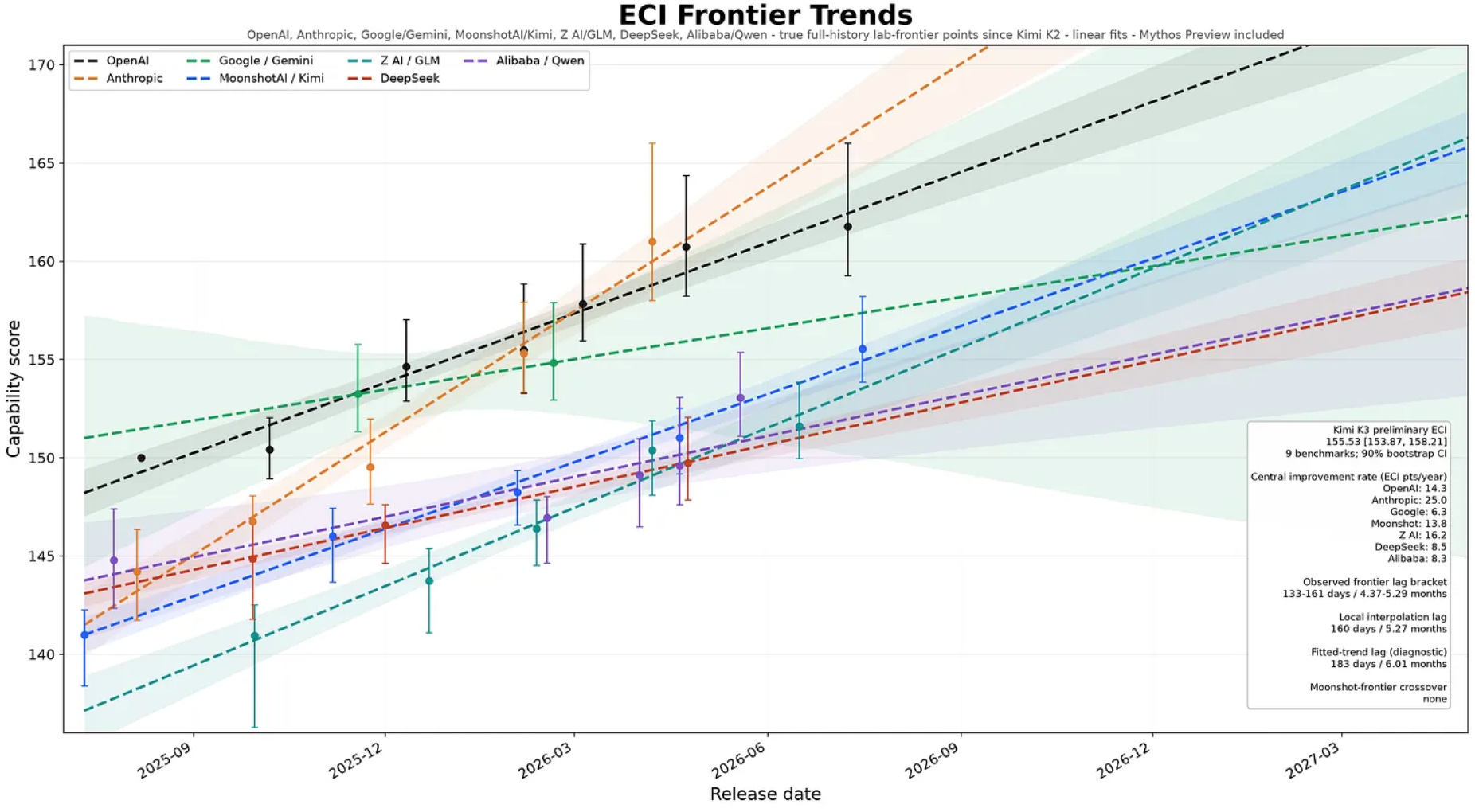
The analysis concludes that “Chinese models have not caught up to the American frontier models nor are they projected to catch up to it” (in line with other experts’ assessments).
Apart from its performance, either on benchmarks or in the real world, K3 is also not particularly small or cheap – and so for this reason alone it’s not evidence that small, open models will make the frontier obsolete.
For Europe, the most important takeaway seems to be that building a strong fast-follower could still be feasible despite a compute disadvantage (with distillation playing some role in explaining K3’s performance, though probably not a decisive one as far as I can tell). Developing fast-follower models would decrease Europe’s dependence on the US and thus improve its bargaining position, even if it doesn’t ultimately obviate the need for frontier model access.
This is not because we think AGI by 2031 is implausible. Rather, we think that inaction could lead to Europe being sidelined even if the technology advances more slowly than the more aggressive predictions.
This is not to deny that some futurists proved remarkably prescient with regard to AI’s current trajectory. But we can agree that the writings of Kurzweil or Asimov would not have been the right basis for public policy.
I am leaning more to Kaltheuners side of analysis but I appreciate the response and debate culture shown by the well thought of reply of you to her piece. Great read and always wonderful to see people engage in a real debate.
We do not know whether Europe 2031 is the baseline. We do know that its central technological trajectory has become sufficiently plausible that Europe cannot responsibly ignore it. The appropriate response is therefore not to bet Europe on that future, but to invest aggressively in capabilities that increase Europe's options across several plausible AI futures, and establish signposts that trigger progressively stronger measures if rapid transformation continues.