
On 12 June, the US government restricted access to Anthropic’s frontier models Fable 5 and Mythos 5 for all non-US-nationals, prompting Anthropic to shut down the models for everyone. The motivation behind the government’s decision is still opaque and may have more to do with domestic politics than with the US-Europe relationship. Still, the restriction is a glimpse into a potential future where frontier model access is not a default for Europe and other middle powers.
Restrictions on frontier model access is one of the things we warned about in Europe 2031 – a hypothetical scenario about Europe’s impending slide into irrelevance if it doesn’t take AI seriously. We published this scenario only two days before the US government issued just such a restriction. As happens so often in AI, reality comes for you almost faster than scenarios can anticipate.
Recent events in the US intensified the ongoing tech sovereignty discourse across European capitals, crystallizing in an urgently needed discussion about access to US frontier models – whether Europe needs it, and if so, how to secure it. Many observers worry that the US government’s decision, whatever its motivation, could set a precedent for more painful things to come soon: a world in which the US no longer shares its cutting-edge AI technology with Europe, or only with costly strings attached.
Others are less concerned. In a recent commentary, economists at the German think tank Dezernat Zukunft argue that the cut-off fears are exaggerated. My reconstruction of their argument is as follows:
P1: Frontier labs are profitable only if they can recoup the enormous cost of training and deploying AI models.
P2: A useful proxy for whether frontier labs can pull this off is how many white-collar workers are able and willing to buy frontier model subscriptions at a given price.
P3: The price of a frontier model subscription is upper-bounded by the availability of open-weight models, whose performance trails the closed frontier by only four months.
P4: Given downward price pressure from open-weight models, profitability requires selling frontier models on the European market.
P5: Decisions by frontier labs – and the US government – over frontier model access are mainly driven by economic logic.
C: Therefore, frontier labs will sell frontier models on the European market.
In contrast to recent policy action (or, rather, inaction) in Europe, which rests largely on an unfounded hope of continued access, the authors at Dezernat Zukunft are fully transparent about their reasoning. This allows me to state clearly which premises I disagree with, and why I end up with a different conclusion. I also agree with two of the authors’ main recommendations, which I discuss below. But first, I will address the premises I doubt, moving from more to less crucial.
Where I disagree with the argument
P3: The price of frontier models is upper-bounded by the availability of open-weight models, whose performance trails the closed frontier by only four months.
This estimate of the performance gap comes from a recent analysis by Epoch AI, indicating that open-weight models lag the closed frontier by four months on average:
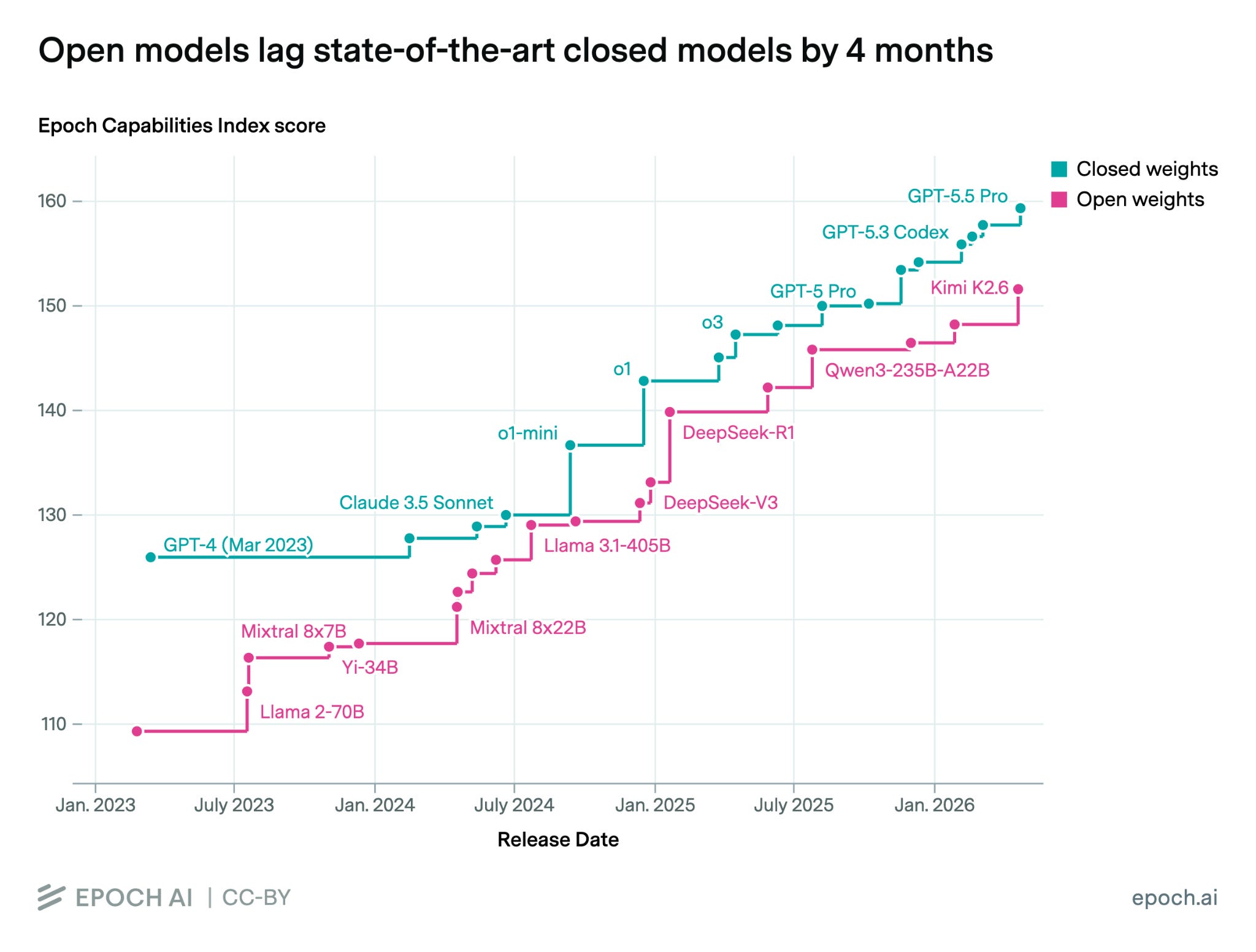
The term “on average” is decisive here. Open models came closest to the frontier in early 2025, when Deepseek used clever algorithmic improvements (and perhaps some distillation) to approximate the performance of OpenAI’s leading model at the time. Recent evidence suggests the gap has been growing since then, as indicated in the chart below from CAISI, the US government’s AI evaluation institute:
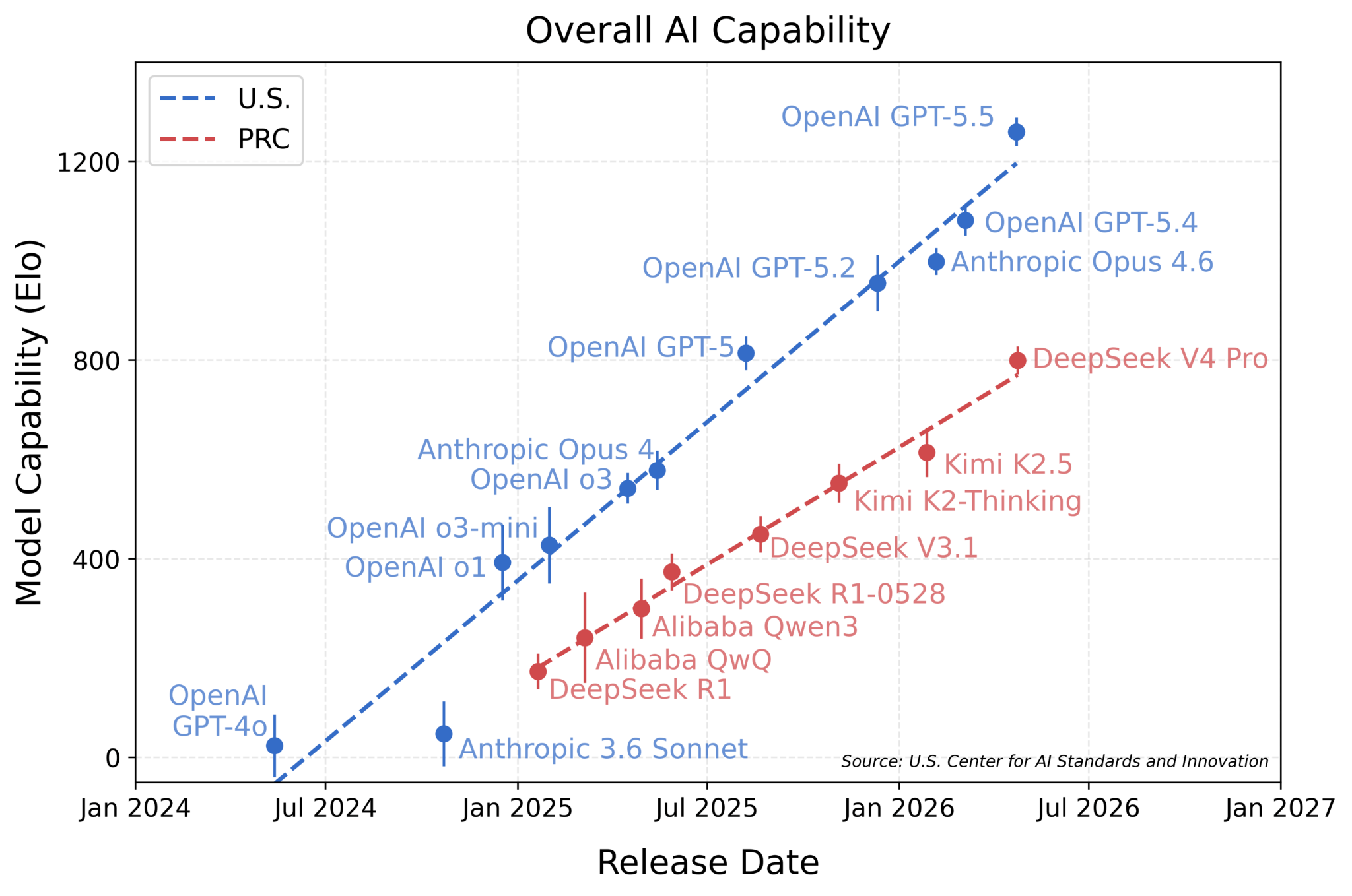
In the future, I expect this gap to become even wider, for three reasons:
First, compute constraints on Chinese and other open-weight developers will really start to bite this year, just as the first GW-scale clusters are coming online in the US. As compute for training and internal R&D remains a key determinant of capability progress, US frontier labs are in a position to pull further ahead.
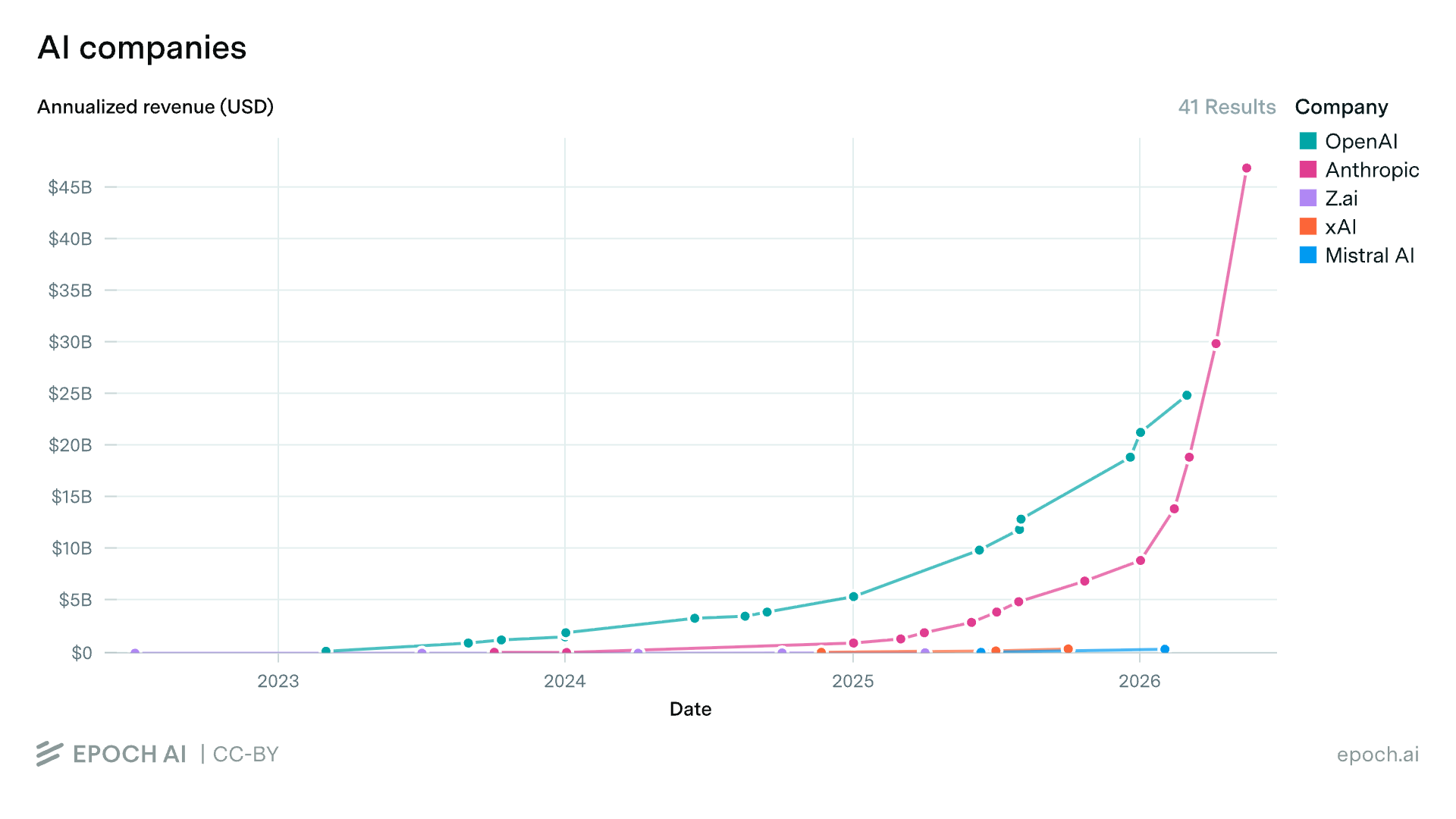
Second, the leading AI companies are now arguably in the early phase of recursive self-improvement, where an increasing fraction of AI R&D is done by AI itself. This leads to compounding effects: incumbents with leading models can use them to build a new, better generation of models more quickly, which then helps to build… and so on. Reportedly, Anthropic engineers are already shipping 8x as much code as before Claude Code was available, which helps them to release better models more quickly and sustain their exponential revenue growth. Such compounding effects make it increasingly hard to keep up with the top labs – which is at least part of the reason why Meta and SpaceX, despite deep capital pockets and lots of data centers, are now struggling to compete at the frontier.
Third, US frontier labs will work hard to prevent Chinese distillation of their models, precisely because this is the obvious move to strengthen their price-setting power.
There is also a more fundamental point, even setting the technical questions aside: nobody knows whether governments will still allow open-weight models remotely close to the frontier in a year or two. If AI capabilities keep progressing exponentially, the misuse potential will be growing fast. This is already a problem today: malicious actors are using image models to create deepfakes and CSAM, and in the case of freely downloadable open-weight models, there is very little one can do to prevent this. In the future, AI systems that can uplift humans in conducting cyber or biological attacks could raise additional concerns. I don’t like the idea of making models with such capabilities freely available, and I assume the same is true for the CCP and the US government (both of which are already exerting political influence on AI model development on national security grounds).
There is thus an internal tension in the idea that because open-weight models are so close to the frontier, they will exert continued downward pressure on model prices: Either open-weight models stay close to the frontier – but then so does their misuse potential, and governments are likely to crack down on them at some point (absent a technical fix against misuse, and we’re not on track for one). Or open models aren’t close – in which case misuse is less of a concern, but then those models also exert little downward pressure on frontier model pricing.
P4: Given downward price pressure from open-weight models, profitability requires selling frontier models on the European market.
The case for this premise is at best incomplete. Open-weight models staying close to the frontier would, all else equal, push frontier prices down. But a second force pushes the other way: compute scarcity makes every model more expensive to serve, open or closed, as they all run on the same, increasingly constrained hardware. Epoch AI estimates that the global supply of inference compute is growing at roughly 3x per year, while demand is growing at 10x (at fixed model size and price). The exact estimates are uncertain, as the authors note, but the underlying trend seems real and in line with recent data from SemiAnalysis showing frontier lab margins rising as compute constraints make token-heavy, agentic AI workloads a scarce resource.
It’s uncertain whether AI demand will continue to exceed supply in this way. But if the recent trend continues and compute becomes sufficiently scarce, those willing to pay for frontier models will face higher prices, while everyday users are forced to use cheaper, weaker models instead. Frontier capability now becomes a real competitive advantage for the select few who can afford the latest models.
In such a world, there could be two different ways for frontier labs to be profitable: either by selling to the highest bidders anywhere in the world or by selling only to the highest bidders in the US, as the US hosts more than enough high-value buyers to exhaust the company’s compute fleet. If frontier lab profitability doesn’t strictly require European buyers, political factors will carry even more weight in access decisions, which brings me to the next point.
P5: Decisions by frontier labs – and the US government – over frontier model access are mainly driven by economic logic.
This premise, implicit to the economic case for wide frontier model access, doesn’t look true even today. The US government’s sudden decision to cut off access to Fable and Mythos arguably didn’t help the US AI industry, partly because it scares the investors and partly because it heavily fuels the debate in Europe over how it could expand its leverage over the AI value chain. As AI capabilities advance, the securitization of AI is only likely to intensify: see, for example, Trump’s recent Executive Order setting up a “voluntary” review framework, where national security agencies including the NSA evaluate frontier models for safety and security before their release.
The more AI becomes a national security concern, and the more the misuse worries are growing, the less will access decisions be made on economic grounds alone. This doesn’t necessarily mean that European companies will be cut off from the frontier. But as Anton Leicht recently argued, it suggests that frontier access won’t be a default, and instead tied to specific conditions. These will have to be negotiated, and Europe currently isn’t in a strong position to negotiate favorable access deals or underwrite them with hard leverage.
P2: A useful proxy for whether frontier labs can become profitable is how many white-collar workers are able and willing to buy frontier model subscriptions at a given price.
This might be a useful proxy today, but I expect it to become less useful over time. As AI models become more autonomous, an increasing share of token demand will be generated by AI agents themselves rather than humans. Think of autonomous enterprises, interacting with humans and human-led companies at first, but eventually shifting a growing share of economic activity into a parallel ‘agent economy’. In this part of the economy, AI agents would buy tokens from AI companies to spawn sub-agents in order to achieve some goal, either handed down to them by a human supervisor or set of their own accord. If this happens – and regulators allow it – AI companies could make an increasing share of their profits from serving AI agents rather than humans.
Points of agreement
While I’m not convinced by the authors’ main argument, I broadly agree with two of their main recommendations.
First, I agree that Europe should build more AI compute. Physical control over a share of global AI infrastructure builds leverage and allows Europe to capture a greater share of AI value creation upstream of the model layer. The crucial question is: Which models are we going to run on this compute? Data centers built by European neoclouds will only host proprietary European or open-weight models. As these are substantially behind the frontier, it’s not obvious that there will be enough demand for them to justify multiple-GW-scale compute buildout.
Right now, only frontier models reliably generate that demand. So we either have to be extremely ambitious and build these models ourselves – which I don’t currently see any real will to do in Europe – or the data centers have to be built mostly by hyperscalers. If we pursue the latter path, we had better ask for something in return – such as guaranteed frontier model access, even if only as a hedge against cut-off scenarios.
Second, I agree that Europe should focus on building leverage through its existing hardware chokepoints (mainly ASML, Zeiss and Trumpf). This would be less a matter of “strengthening” these chokepoints, as these companies already control 100% of their respective layer in the supply chain for leading-edge AI chips. What Europe can do is help these companies expand their production capacity and tie that to access guarantees from the US, whose AI industry would benefit heavily from any relief of the EUV chokepoint. Even more importantly, as we argue in Europe 2031, it should build a middle power coalition with countries such as Japan, South Korea, Canada or Australia, as it would only then be able to negotiate on eye-level with the US.
Bottom line
I suspect that, as so often in AI policy, a disagreement over one thing – here, the economics of frontier access – really comes down to a more fundamental disagreement about AI capability trajectories.
If AI is a “normal technology” – mostly a helpful tool that automates some fraction of white-collar work, but not an economic or geopolitical phase shift – it’s relatively more plausible to think that frontier models will be a commodity.
If, however, AI is much more than that – a genuinely transformative, general-purpose technology, able to confer decisive strategic advantages across the economy and warfare – it’s hard to see how it would not become heavily securitized, with political considerations having at least as much of an impact on access decisions as economic considerations. On economic grounds alone, exponential capability growth, unprecedented compute scarcity and agent economies could affect the profitability calculus of a frontier company in ways that would be quite unusual for previous technologies.
This was not a detailed modeling exercise, and I’m not an economist in any case. Hence, I cannot confidently answer whether or not economic forces alone will incentivize European frontier model access. But given the current evidence, relying on continued European access on market size grounds strikes me as a risky bet. Europe needs a plan for the less favorable case.